25 Designated Pilot Hospitals Announced: International Medical Tourism Emerges as Guangzhou’s New Service Sector Growth Engine
In recent years, international medical tourism has become a vital driver of growth within the global wellness and healthcare industries. Across China, several major cities are already taking decisive action to transform themselves into international consumption hubs and build globally competitive destinations for medical tourism.
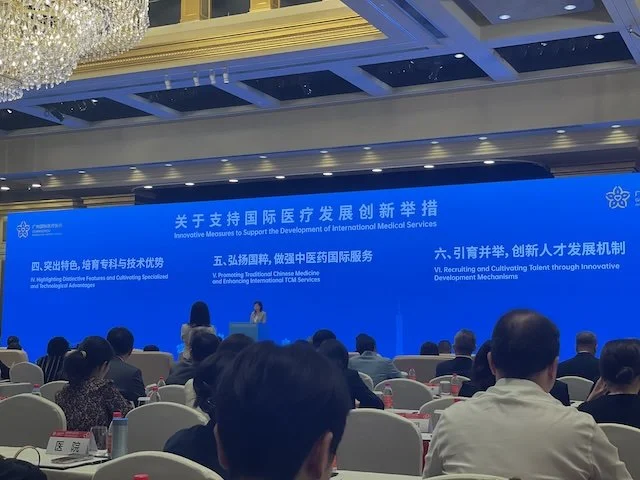
On the morning of April 29, the Guangzhou Municipal Health Commission officially unveiled 12 innovative measures to support the development of international medical services. The announcement was made during the launch event of the Guangzhou International Medical Tourism Service Center.
Concurrently, leveraging the full-chain industry advantages of Lingnan Group—spanning culture, commerce, tourism, and exhibitions—Guangzhou has officially established a one-stop international medical tourism platform: the Guangzhou International Medical Tourism Service Center. This new center brings together resources from 17 designated international medical service pilot hospitals across the city.
As one of China’s top three medical hubs and a core city in the Guangdong-Hong Kong-Macao Greater Bay Area (GBA), Guangzhou boasts premier medical resources, the unique heritage of Lingnan culture, and highly convenient international transportation connectivity.
Over 20% Year-on-Year Growth in Foreign Patient Visits
According to data released at the event, Guangzhou welcomed over 3.2 million inbound foreign visitors in 2025. During the same year, the total number of expatriates and international patients seeking medical treatment in Guangzhou surged by more than 20% year-on-year. International medical tourism is rapidly establishing itself as a powerful new growth engine for the city's service sector.
At the end of March this year, the Health Commission of Guangdong Province published its inaugural list of 25 international medical service pilot hospitals. Notably, Guangzhou alone accounted for 17 of these selected provincial-level institutions.
The comprehensive list of the first batch of 25 designated international medical service pilot hospitals in Guangdong Province includes:
Guangzhou Municipality (17 Designated Institutions)
Guangdong Provincial People's Hospital
Guangdong Women and Children Hospital
The First Affiliated Hospital, Sun Yat-sen University(including Yuexiu Campus and Nansha Campus)
Sun Yat-sen Memorial Hospital, Sun Yat-sen University
The Third Affiliated Hospital of Sun Yat-sen University
Zhongshan Ophthalmic Center, Sun Yat-sen University
Sun Yat-sen University Cancer Center
Hospital of Stomatology, Sun Yat-sen University
The Sixth Affiliated Hospital, Sun Yat-sen University
Nanfang Hospital, Southern Medical University
Zhujiang Hospital of Southern Medical University
The First Affiliated Hospital of Jinan University
Guangdong Provincial Hospital of Chinese Medicine
The First Affiliated Hospital of Guangzhou Medical University
Guangzhou First People's Hospital
Guangzhou Women and Children's Medical Center
Clifford Hospital
Shenzhen Municipality (4 Designated Institutions)
Shenzhen People's Hospital
Peking University Shenzhen Hospital
The University of Hong Kong-Shenzhen Hospital
Shenzhen Hospital of Southern Medical University
Zhuhai Municipality (2 Designated Institutions)
The Fifth Affiliated Hospital of Sun Yat-sen University
Zhuhai People's Hospital
Shantou Municipality (1 Designated Institution)
The First Affiliated Hospital of Shantou University Medical College
Foshan Municipality (1 Designated Institution)
Foshan Fosun Chancheng Hospital
Chen Bin, Party Secretary and Director of the Guangzhou Municipal Health Commission, emphasized that Guangzhou aims to establish a premium brand for international medical services. Moving forward, the city will prioritize supporting designated pilot institutions to expand their international healthcare offerings. The commission will help these institutions build internationalized medical teams, streamline foreigner-oriented service workflows, and construct a high-quality, comprehensive service ecosystem covering everything from outpatient clinics and inpatient care to ancillary diagnostics.
The 12 innovative measures rolled out by the Guangzhou Health Commission specifically include:
Supporting wholly foreign-owned hospitals in introducing renowned international medical brands.
Encouraging high-level hospitals to establish international specialty clinics.
Accelerating the clinical roll-out of innovative drugs and medical devices.
Enhancing capabilities in diagnosing and treating complex, rare, and difficult diseases.
Developing clusters for advanced therapies and integrated Traditional Chinese and Western medicine.
Encouraging medical institutions to pursue international accreditation to standardize quality of care and technical applications.
Furthermore, the Guangzhou Health Commission highlighted plans to make it easier for physicians and nurses from overseas, as well as from Hong Kong, Macao, and Taiwan, to practice at multiple sites within Guangzhou. The city is exploring the inclusion of eligible overseas medical professional qualifications into a recognized registry and establishing a title evaluation system that aligns with international standards. Additionally, efforts will be made to optimize price management for international medical services and explore innovative payment models, such as bundled payments. These measures demonstrate that while Guangzhou is innovating its talent development mechanisms, it is also actively refining its regulatory framework for international medical pricing.
Bridging the Full Service Cycle: From Pre-Arrival to Post-Discharge
For a long time, China was primarily a "source country" for outbound international medical travel. However, in recent years, inbound medical tourism has steadily gained momentum. This shift is driven by China's technological advantages in specific medical specialties, the rapid development of its innovative pharmaceutical and medical device industries, a greater level of national opening-up, and the "natural traffic" generated by the global Chinese diaspora. Nevertheless, scaling the international medical tourism industry still requires the construction of a robust and fully mature support ecosystem.
The newly formed Guangzhou International Medical Tourism Service Center addresses this by offering full-cycle care covering three distinct phases: pre-arrival, on-site, and post-departure. Services range from visa assistance and remote pre-consultations before arriving in Guangzhou, to language translation, accommodation, and catering during the stay, through to post-operative rehabilitation and remote follow-up care after leaving the city.
Wu Chen, General Manager of the Guangzhou International Medical Tourism Service Center, noted that the center does not merely facilitate medical travel. More importantly, it focuses on integrating Guangzhou’s premium medical resources, distinct cultural tourism assets, and cross-border commercial health insurance. By doing so, it serves Guangzhou’s broader goal of becoming an international consumption hub while unlocking new momentum in wellness-driven consumer spending. Moving forward, the center will focus on strengthening its comprehensive service capabilities, driving industry crossover and integration, and expanding its global cooperation network to build a product ecosystem where healthcare, wellness, and tourism are deeply intertwined.
During the event, Wang Hongbin, Deputy Director of the Health Commission of Guangdong Province, also revealed that Guangdong is fully committed to building an international medical service highland and capturing a share of the rapidly growing medical tourism market. Following extensive consultations, Guangdong is preparing to collaborate with various provincial-level functional departments to issue a series of measures supporting international medicine. These will span financial insurance, inbound tourism, visas, and multi-site practice for doctors, ensuring sustained momentum for the growth of Guangdong's international medical and health industries.
CMTF:Connecting China with Global Healthcare
China International Medical Tourism Fair (CMTF), serves as China’s leading international medical tourism fair. As a UFI-Approved Event, CMTF stands as the definitive platform for the cross-border healthcare industry.
Dedicated to integrating premium global medical resources, the fair covers critical sectors including Assisted Reproduction (ART), Cell Therapy, Anti-Aging, Precision Medicine, and Longevity Technology. For more event info, please visit: https://www.cnmeditours.com/medical-tourism
Join us at our upcoming stops and secure your booth today:
👉 Next Stop: July in Shenzhen
👉 Future Dates: November in Beijing | March in Chengdu
👉 Contact us for speaking/exhibiting: +86-13570219945 (Phone & Whatsapp& WeChat)